Custom tuning for supported Focus ST, Focus RS, Fiesta ST and Raptor applications. Start with your exact vehicle, tuning device, hardware and fuel so I can confirm the right route before you order.
A setup inquiry is free. Pricing and the work included are confirmed for your vehicle before payment.
PROVEN ON A REAL FORD BUILD
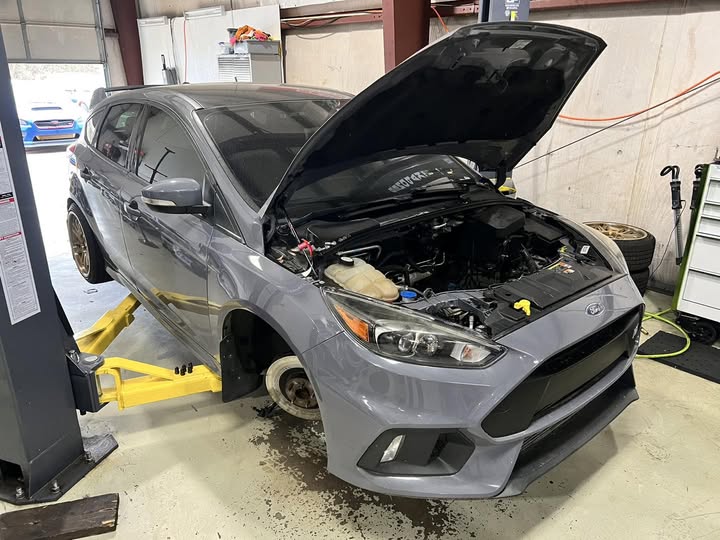
Jaycee’s 2017 Focus RS.
Original AWD Tuning photo · March 2023.
Built from the ground up at AWD.
I worked on Jaycee’s RS as a complete build, bringing the engine, turbo and calibration together. The archive follows the project from its earlier 2022 session to the 2024 PTE/93-octane and “w-meth” records.
434.0 hp · 416.0 lb-ft September 25, 2024 individual report, with WCF correction.
These are staged development results, not a tune-only comparison. The full story includes the original graphs and explains the differences between report views.
The ST and RS use different applications; an Accessport for one is not automatically correct for the other. Send the model year, market, device part number and current map, along with intake, intercooler, turbo and fueling changes.
Tell me what you want from the car: daily response, track use or refinement after hardware changes. We agree on the fuel and tuning scope before starting.
Confirm that the car is an ST and identify its model year and market. Include the intake, intercooler, turbo, boost-control and fueling parts actually fitted; a parts list is more useful than a stage label.
A calibration needs to match the fuel you can consistently buy. State the pump-fuel grade and rating system, plus any ethanol blend and how you measure it.
Start with the full model: F-150 Raptor, Raptor R, Bronco Raptor or Ranger Raptor. Include the year, engine, transmission and market. The Raptor name alone does not identify the correct tuning product or confirm custom-tuning access.
Describe towing, terrain, tire changes and how you use the truck. Engine and transmission calibration are reviewed separately; an engine-tuning device does not establish transmission support.
Year, exact model, engine, transmission and country/market. Add the Accessport part number, installation status, current calibration and any previous tuner information.
Hardware, fuel and condition
List exact parts and the fuel you will use. Describe warning lights, misfires, leaks or other concerns before tuning; calibration cannot repair a mechanical fault.
Your goal and location
Explain what you want to improve and whether you prefer remote tuning or an in-person session. For dyno work, include your location and available facility.
Review the setup. I confirm vehicle support, equipment, fuel, pricing and the work included before payment.
Prepare and log. Follow the instructions for your file and record the channels requested for your exact Ford. Subaru parameter lists are not a Ford logging checklist.
Review and revise. Send the original logs and driving feedback through the agreed delivery channel. I use them to develop the calibration and confirm when the tune is complete.
Use a suitable battery-support supply for flashing and follow the vehicle-specific procedure. A base map or intermediate revision has its own operating instructions; do not assume it is ready for full-load use.
Confirm the part number, supported vehicle and that it was properly uninstalled from the previous car. Send those details before buying; a device being physically able to plug in does not establish fitment or licensing.
Can I tune for an ethanol blend?
Send the intended blend, fuel-system hardware and how ethanol content is measured. I review the equipment and available software before agreeing on a fixed-blend or flex-fuel strategy. Switching fuels is not automatically supported by every map.
How much power will my Ford make?
That depends on the engine, turbo, fuel, hardware, condition and test method. We set goals for the complete setup and evaluate drivability as well as output. Another car’s dyno figure is not a promised result.
Can we use a dyno instead of remote logs?
Yes, by arrangement. Send your location and facility details so we can plan instrumentation, scheduling and the work needed. Dyno access and travel are agreed separately.